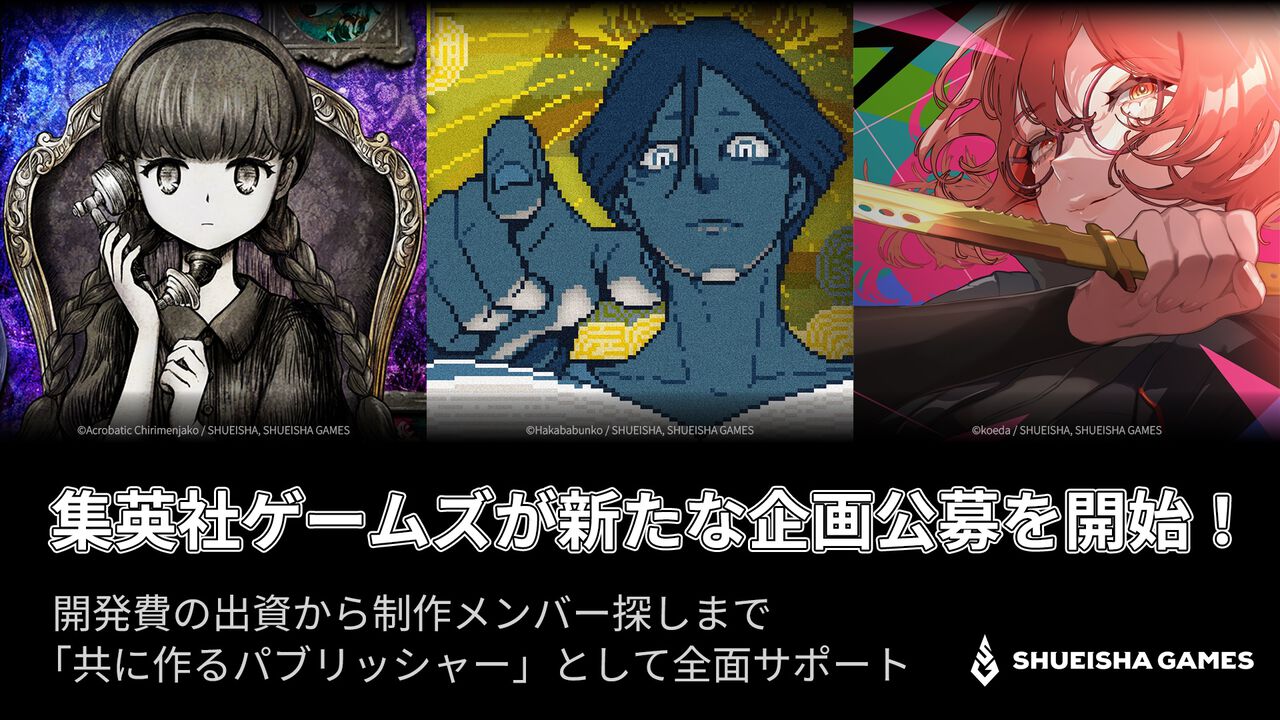

Shueisha Games has opened a new project call for game creators, and the pitch is broader than a standard publishing submission. According to Famitsu, the company began accepting new proposals on May 19, 2026, with support that can include development funding, staffing help, production management, QA, localization, promotion, and even game-adjacent IP expansion.
For indie developers, the most interesting part is the entry point: applicants need a game proposal and a portfolio of past creative work. That portfolio does not have to be limited to games.
What Creators Need to Submit

- Required: A game proposal covering the concept, development budget, schedule, and team
- Required: A portfolio showing previous creative work
- Optional: A current build if development has already started
- Optional: Trailer, gameplay video, specs, scripts, setting materials, or other production documents
What Shueisha Games Says It Can Support
The support menu goes well beyond “we will market your finished game.” Famitsu’s report lists progress and budget management, development funding, development equipment and software lending, recruiting support for missing team members, platform and media outreach, store procedures, promotion, visual asset production, QA, localization QA, and IP expansion through goods or related projects.
That makes this more like a co-development and incubation path than a simple publisher inbox.
Why Shueisha Is Interesting Here
Shueisha is best known globally through manga culture, including the ecosystem around Weekly Shonen Jump. Shueisha Games, however, has been building a different lane: creator-led games with strong concept hooks, including titles connected to Game Creators CAMP and projects such as Urban Myth Dissolution Center and Schrödinger’s Call.
The opportunity is obvious. If Shueisha Games can find small teams with strong worlds, characters, or visual identities, those projects may have room to grow beyond the initial game. For JPBound readers, this is exactly the kind of Japan-industry story worth watching: manga publishers are not only adapting existing IP into games; they are also scouting original game IP from the ground up.
Who Should Pay Attention?
Indie developers with a clear concept but limited production resources should look closely. So should artists, writers, and small creative teams who have not shipped a full commercial game yet but can prove they can make compelling worlds and characters.
The catch, as always, is that a proposal still needs discipline. A cool idea is not enough. Shueisha Games specifically asks for budget, schedule, and team information, which means creators should treat this like a real production pitch rather than a dream-board submission.
How This Differs From a Normal Indie Submission
NeuronWriter’s structure pulled up common indie funding questions, and this project call answers several of them directly. Shueisha Games is not only asking for finished games. It is inviting creators to bring a proposal, budget, schedule, team plan, and creative portfolio. That makes it potentially useful for teams that have a strong concept but still need production help.
The support list is also unusually practical. Funding matters, but so do QA, localization, platform relations, promotion, and staffing. Many small teams can build a prototype; fewer can carry that prototype all the way through release, storefront approvals, marketing assets, localization checks, and post-launch visibility.
The Manga-Publisher Angle
Shueisha’s presence makes this especially interesting for JPBound readers. The company’s core identity is still tied to manga, but Shueisha Games gives it a way to discover new worlds before they become established IP. A strong indie game concept can start as a game, then potentially expand into merchandise, comics, animation, or other media if the audience responds.
That does not mean every accepted project becomes the next big cross-media franchise. It does mean Japanese publishers are increasingly treating games as original IP pipelines, not just as adaptations of existing manga and anime.