
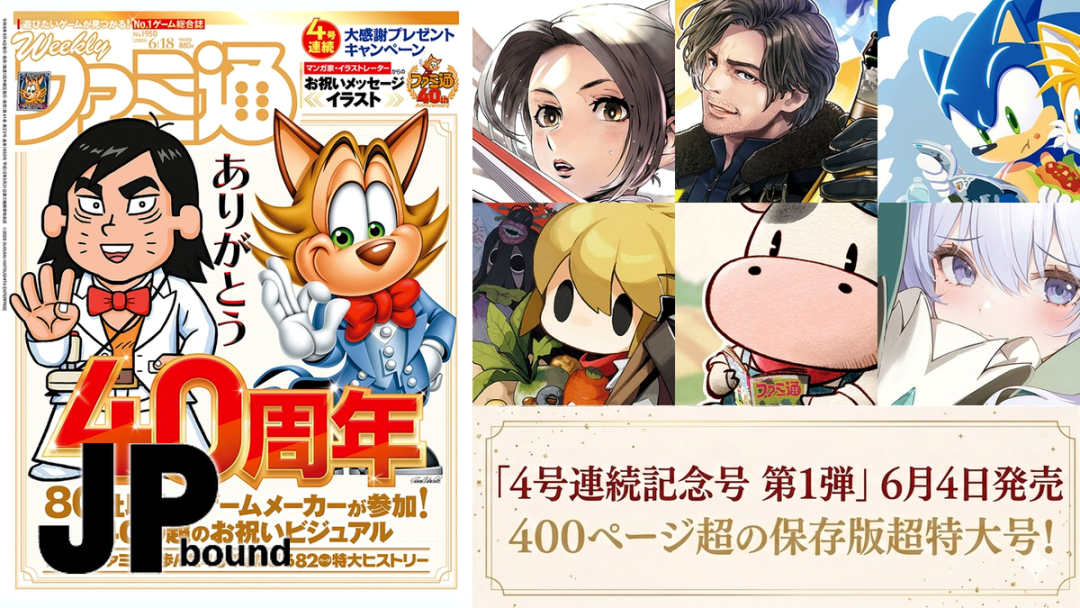
There are gaming magazines that people read for news, and then there are magazines that become part of how a country remembers games. Weekly Famitsu belongs to the second category. Its scores, covers, mascots, interviews, jokes, and thick special issues have all become part of Japan’s game culture archive.
Famitsu’s 40th anniversary issue was released on June 4, 2026. Famitsu says the commemorative issue runs over 400 pages and includes features looking back on 40 years of game history, tribute visuals from game companies, contributions from manga artists, and a catalog of titles that received perfect scores.
Forty Years From Famicom Tsushin
Famitsu’s own 40th anniversary site says the magazine reaches the milestone on June 6, 2026, tracing its beginning back to Famicom Tsushin on June 6, 1986. That origin matters. The name itself carries the early console era, when the Famicom was not a retro object but the center of a new home entertainment culture.
Over four decades, Famitsu became more than a weekly game magazine. It became a place where Japanese games were announced, reviewed, ranked, argued over, and preserved. For players outside Japan, the name often reached them through review scores or translated news. For readers in Japan, it was also a routine: a weekly rhythm of pages, previews, columns, and industry noise.
The 40th anniversary issue is built like an object of record. A 400-page-plus commemorative issue is not only about nostalgia. It is a physical statement that the magazine sees its own history as inseparable from the history of Japanese games.
What Is In The Anniversary Issue
Famitsu’s announcement describes a packed issue with multiple special projects. Confirmed elements include a 40-year game history feature, celebration visuals from game companies, manga-artist contributions, and a perfect-score catalog.
That last item will get attention because Famitsu’s scoring system has always had a strange international afterlife. The magazine’s four-reviewer, 40-point format became famous partly because a perfect 40 carried weight, and partly because people loved debating whether it should have. A catalog of perfect-score games is not just a list of praised titles. It is a map of what Famitsu, at different moments, recognized as exceptional.
The tribute visuals are just as important in a different way. Game companies celebrating Famitsu’s anniversary means the issue is also an industry mirror. It shows which publishers and creators understand Famitsu as part of their own history.
Why Famitsu Still Matters Outside Japan
It is fair to ask whether a Japanese weekly game magazine still matters internationally in an era of instant trailers, livestreams, social platforms, and global storefronts. The answer is yes, though not in the same way it once did.
Famitsu is no longer the only window many overseas fans have into Japanese games. But it remains a useful cultural reference point. When Famitsu gives space to a game, frames an anniversary, gathers creator comments, or looks back at an era, it is documenting Japanese game culture from inside the industry that shaped it.
For researchers, collectors, translators, and longtime fans, that archive function is valuable. Magazines catch texture that press releases do not: layout choices, advertisements, reader-facing language, running columns, and the way certain games were positioned before hindsight made them obvious.
A 40th anniversary issue gives that texture a formal frame. It says: here are four decades of games, not as a clean timeline, but as something lived week by week.
A Magazine As Memory
There is a particular feeling to old game magazines that websites rarely reproduce. They show what mattered at the time, including things that later vanished. A preview for a game that became a classic sits beside one nobody remembers. A small ad becomes more interesting years later than the headline feature. The ordinary pages become historical evidence.
That is why Famitsu’s 40th anniversary is more than a birthday notice. Japanese games changed the world, and Famitsu spent 40 years recording those changes from close range. The new commemorative issue is a celebration, but it is also an invitation to look at games as culture with memory, not just products with release dates.
For anyone who grew up reading about Japanese games from afar, Famitsu was often part of the signal. Sometimes direct, sometimes translated, sometimes only visible through a score box passed around online. Forty years later, that signal is still worth paying attention to.
