
If you’re a fan of romantic comedy or slice-of-life anime, you’ve probably seen at least one Valentine’s Day episode.
To a certain degree, these plots reflect the popularity of this Western holiday in Japan. But, at the same time, comedies do tend to exaggerate.
How accurate are Valentine’s Day anime episodes? What do they get right about the holiday? What do they get wrong? First, let’s go over some key details to help you understand how the holiday works.
Are There Different Categories of Valentine’s Chocolate?
Yes, there are many kinds of Valentine’s Day chocolate in Japan. The three main categories are:
- romantic or honmei choco (本命チョコ) — given to a lover
- friend or tomo choco (友チョコ) — given to friends, which accounts for some of the “extremely popular boy” and “girl to girl” giving in anime
- obligation or giri choco (義理チョコ) — given to co-workers and others to be polite
A quick Google search shows that it is possible to get honmei and giri choco mixed up, or to get conflicting signals. However, it’s hard to say if this miscommunication happens as often in real life as it does in anime.
Incidentally, some people question whether “obligation” choco is necessary, or even whether the practice is appropriate or not. But in the meantime, the tradition still continues. As an example, many English teachers in Japanese Eikaiwas may receive “obligation” chocolate from their students or other staff.
In addition to the three main types, there is also “reverse” (from boy to girl) chocolate. Other kinds include:
- Jibun choco (自分チョコ) or jiko choco (自己チョコ) — given by women to themselves
- Ore choco (俺チョコ) — similar to jibun choco, but for men
- Family or kazoku choco (家族チョコ) — given by family members
Valentine’s Day in Anime

A typical Valentine’s Day (バレンタイン デー) anime episode will feature a girl giving chocolate to the boy that she likes.
In some cases, characters will make personalized chocolate treats. If the series is silly, there will be at least one chocolate-making disaster. For example, the chocolate may disappear due to excessive “tasting.” Or the results may be funny-looking or taste weird.
Once the chocolate is made (or bought), it still has to be given out. Expect to see a lot of red-faced embarrassment. Tsundere denial (“I’m not giving you this because I like you”) is also common. If it’s a harem series, or if rivals exist, things will get competitive.
In some shows, a character will accidentally mistake friendship chocolate for the romantic kind.
A few shows will even depict White Day, when the roles are reversed.
In the end, some couples will be happy, and some will bicker (as usual). Some popular kids will get tons of chocolate, while others will be devastated that they didn’t get any.
Anime Examples
- In the Haruhi-chan gag-comedy spin-off series, Yuki eats the chocolate carefully prepared by Haruhi and Mikuru.
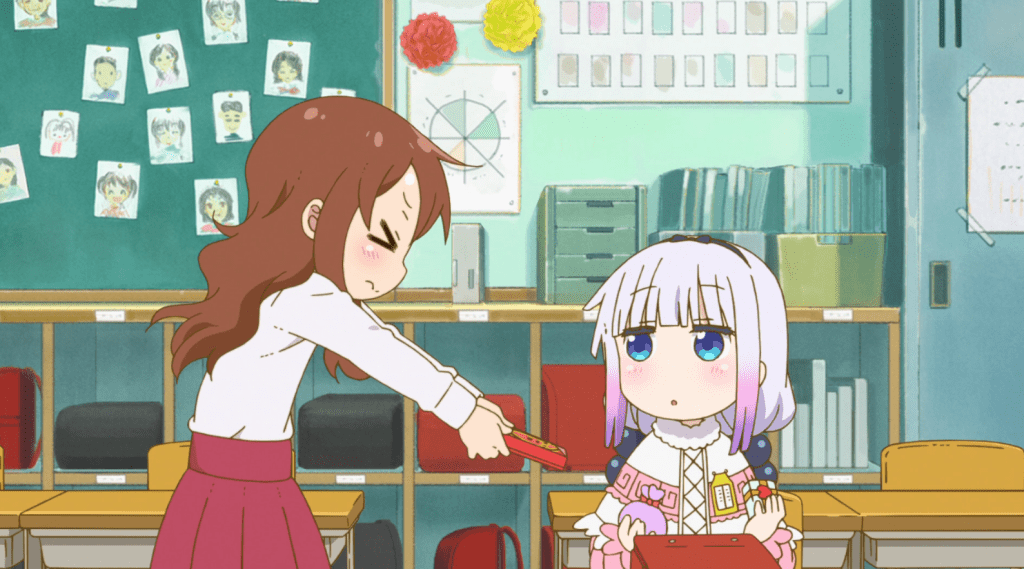
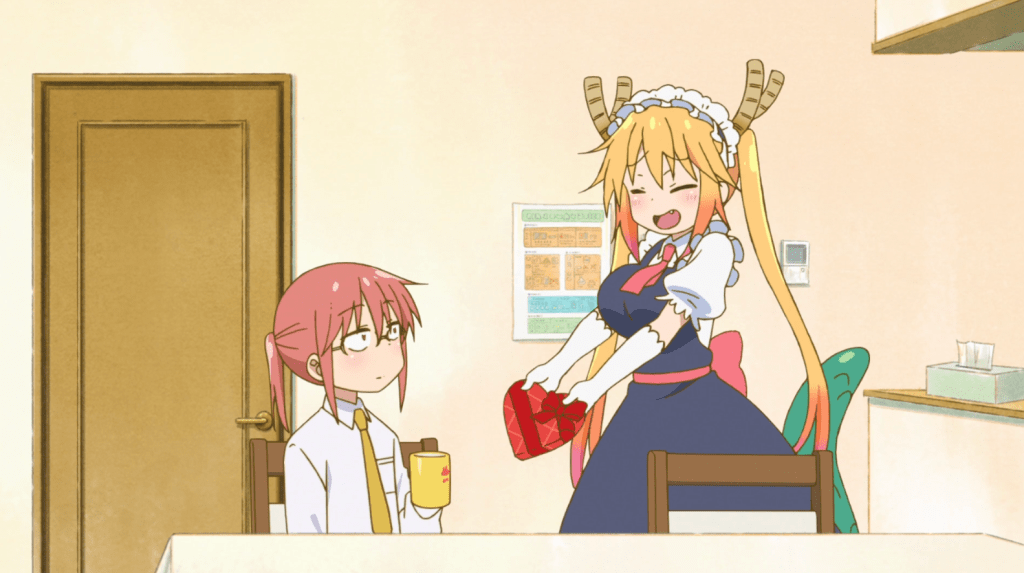
- In Miss Kobayashi’s Dragon Maid, Tohru makes her own chocolate so she can add a love potion to it. Schoolgirl dragon Kanna Kamui also has a cute chocolate scene with Riko Saikawa, who has a crush on Kanna.
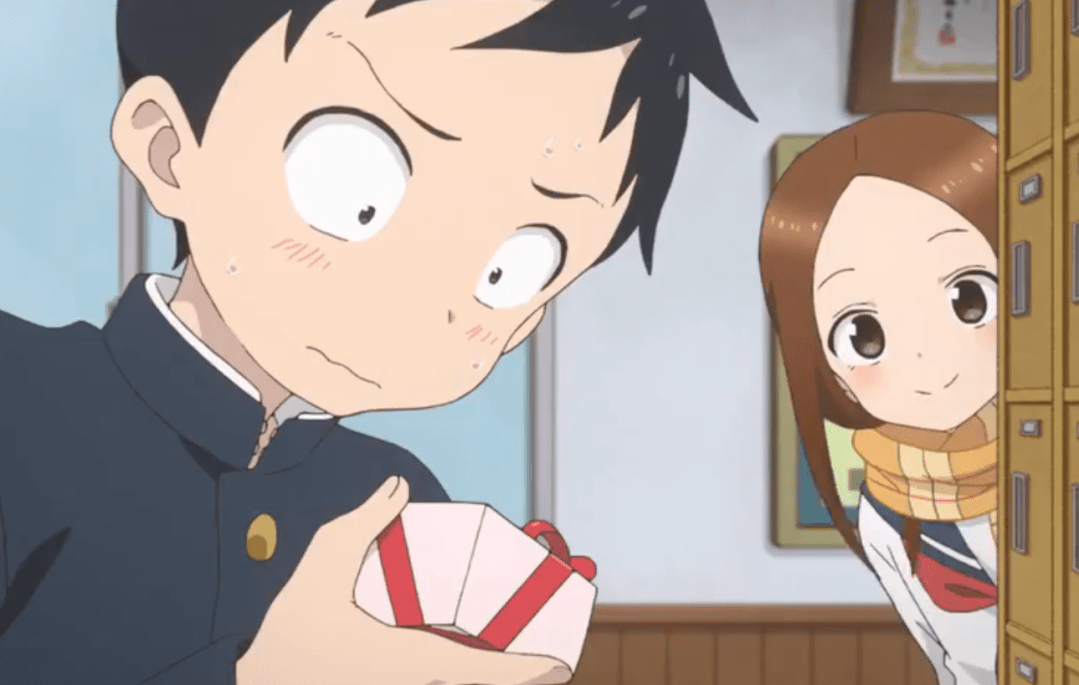
- In Teasing Master Takagi-san, Nishikata discovers a mysterious box of chocolates in his shoe locker. Takagi teases him about whether the chocolate came from her or not.
Anime vs. Reality
We won’t attempt to compare romantic rivalries with real life. But beyond that, how realistic is a typical Valentine’s Day anime episode?
Are Girls the Only Ones Who Give Chocolate?
Girls and women are the primary givers, but it’s more complicated than that.
Since Valentine’s Day is a romantic holiday, you might expect Japanese couples to give each other gifts. That’s certainly the case with Christmas in Japan. But that’s not true for Valentine’s Day in Japan.
So how did Japanese women end up giving men Valentine’s Day gifts? Some say it might have started out as a misunderstanding, or a translation error.
Other sources say that the postwar “Bubble” economy of the 1970s gave women more buying power, and more social obligations to give chocolate.
Either way, chocolate companies advertised chocolate as a way for Japanese girls and women (stereotypically depicted as shy) to say, “I love you.”
And the day’s not just for lovers, either. Eventually, the holiday grew to include “obligation chocolate” for co-workers.
Today, it’s OK for boys or men to give chocolate as well. This is known as gyaku choco (逆チョコ), or reverse chocolate — because it’s the opposite of what’s expected.
Incidentally, the whole holiday seems to skew young. People associate the event more with young women and schoolgirls than with older adults, according to reports.
Is Valentine’s Day in Japan All About Chocolate?

Yes, for the most part. According to reports, the chocolate tradition seems to have several origins.
First, Morozoff, a Japanese company founded by a Russian, tried to sell boxes of Valentine’s Day chocolate in 1935. (Or possibly 1932 or 1936 — online sources don’t agree.)
But the idea didn’t really catch on until 1958-1959, when another company, Mary’s Chocolate, began to promote Valentine’s Day chocolate in Japan. After a slow start, Valentine’s Day now makes up about 20 percent of Japan’s total chocolate.
Note that alternatives to chocolate do exist for people who don’t like chocolate; are allergic to chocolate; or are looking for something different. But chocolate remains the traditional favorite.
Are Valentine’s Day Chocolates in Japan Handmade?
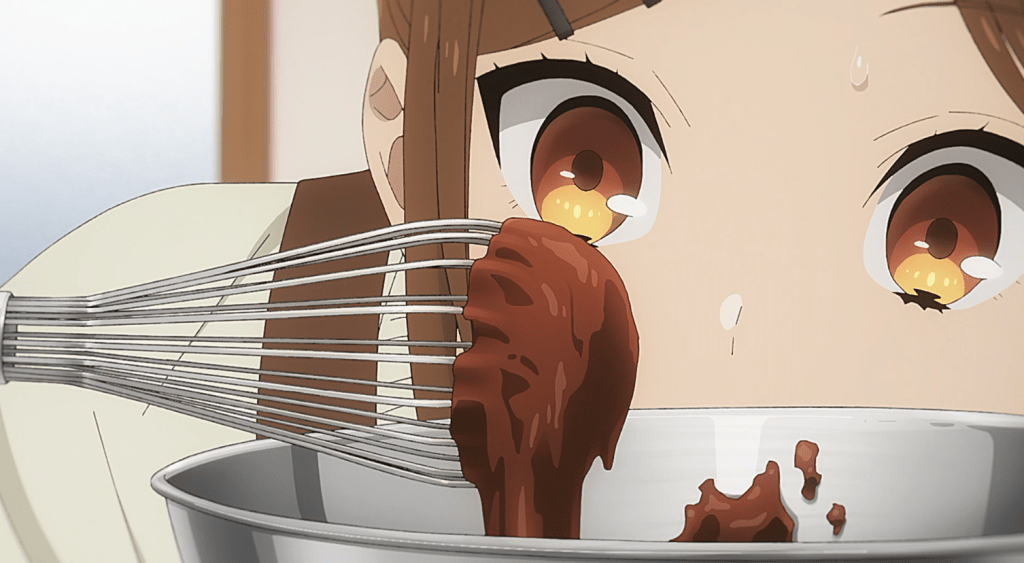
This one is difficult to prove or disprove. Some people do make their own chocolates for Valentine’s Day.
You can find videos of people making handmade chocolate treats for Japanese Valentine’s Day. However, other people say that they got the idea from watching anime episodes.
It also depends on what you mean by “make”. Many people will simply buy chocolate, melt it down, and then reshape it into the shape of their choice.
At the same time, companies sell plenty of heart-shaped boxes, special Valentine’s chocolates, and also more generic chocolate items for impersonal giri choco gifts. Certainly, it’s a lot easier to buy chocolate, even if it lacks the personal touch.
But, buying ready-made chocolates can be expensive. The Japan Times states that Japanese women spent an average of ¥5024 in 2024 (or $30.11 in U.S. dollars) on Valentine’s Day chocolates.
What is White Day?
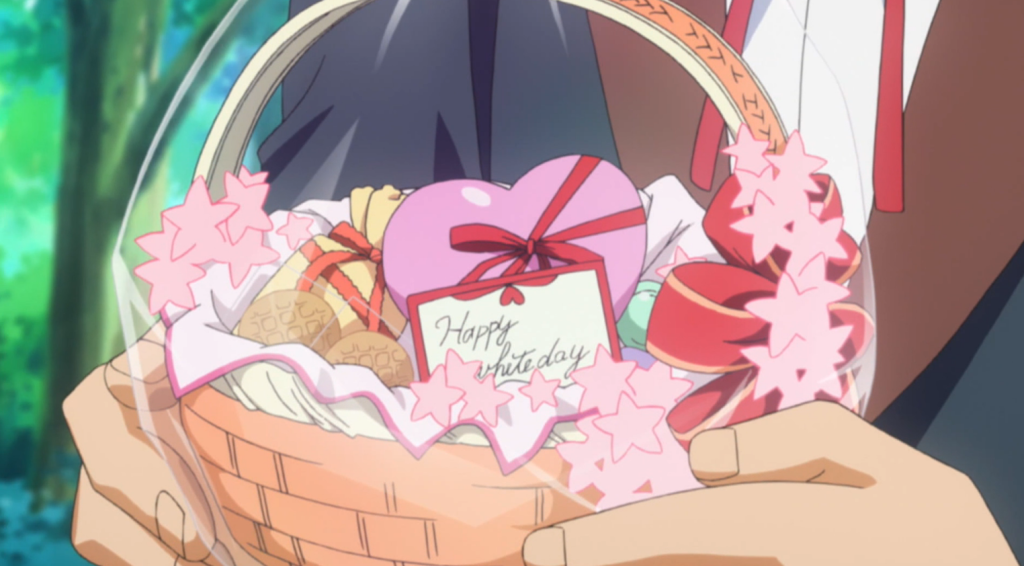
So far, we’ve shown that while anime tends to exaggerate, Valentine’s Day in Japan is indeed mostly a day for girls and women to give out chocolate. This is completely contrary to how the holiday works in Western countries where the onus is on the men to give chocolates to the women in their lives.
But in Japan, White Day is the traditional day for Japanese boys and men to respond to Valentine’s Day. It takes place on March 14, one month after Valentine’s Day.
On White Day, men and boys return the favor for the chocolate received on Feb. 14. It meshes well with the Japanese tradition of okaeshi (お返し), a thank-you gift given after receiving one.
But Why White?
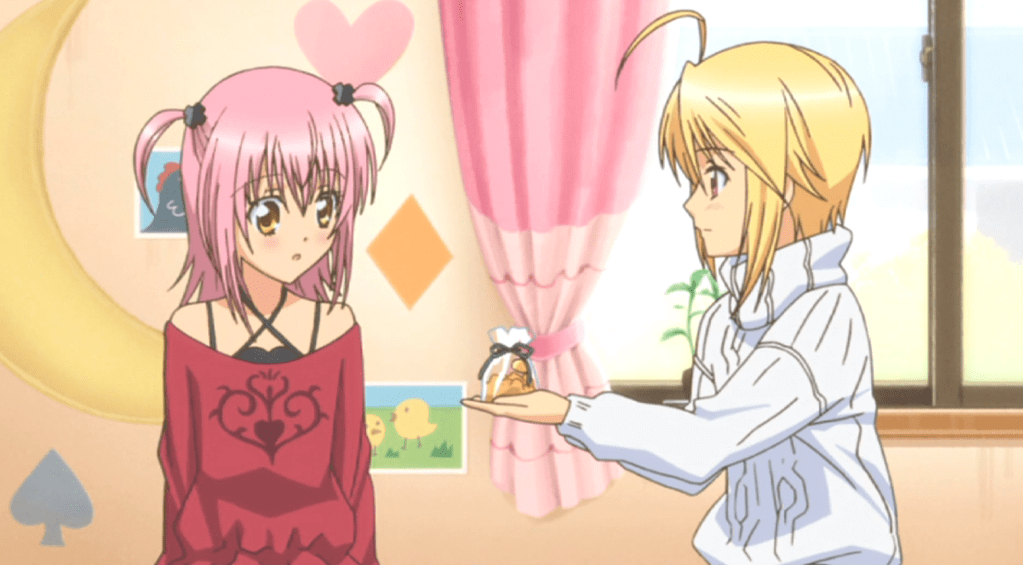
White Day started in the late 1970s. According to one version of the story, it was originally called Marshmallow Day in 1977.
Apparently, a confectionary shop in Fukuoka got the idea from a customer who thought women should have their own gift-receiving day. She wrote that she would settle for “even marshmallows.” The store took her literally.
The original Marshmallow Day marshmallow wasn’t plain, but chocolate-filled. Regardless, the marshmallows soon fell out of popularity, and the holiday was renamed White Day.
For White Day, the gift should be white (or white-ish, like cookies, or even pink), and something she would like.
The Historical Origin of Valentine’s Day

The holiday is named after a Christian martyr called Saint Valentine. As with a lot of early Christian saints, we don’t have many solid facts about him — he may have even been based on two people.
As the story goes, Valentine was executed by the Roman Empire, back when they still persecuted Christians. According to legend, he wrote the first Valentine — a letter that he signed, “Your Valentine.”
Valentine became the patron saint of lovers. And until the Catholic Church removed it in 1969, his feast day was Feb. 14.
Despite this demotion, lots of people in the West still celebrate with Valentine’s Day cards, chocolate, candy hearts, etc.
Although the Japanese version is different, it does share the Western emphasis on buying stuff to show you care.
I hope this helps you better understand Valentine’s Day in Japan. Let me know any questions you may have in the comments below!
