

Until Then is a very special kinetic visual novel and breakout success from Filipino indie game developer Polychroma Studios. Admittedly, I knew nothing about the gamdev scene in the Philippines before stumbling upon this game by chance, and I’m so glad I did. Blending real-world events with a perfectly executed branching timeline narrative, warm pixel art, and one of the best soundtracks I’ve ever heard in a video game, Until Then made me laugh, cry, and reflect, all the way to the end.
If you’re a fan of games like A Space for the Unbound or ghostpia, this game will be right up your alley. I had the rare chance to interview some of the Polychroma Games team at Tokyo Game Show this year and some of their thoughts and insights into the game’s development will be included in the sections below.
The Story
Until Then follows a high schooler named Mark Borja who seems to be coasting his way through life, hanging out with his two best friends, doing class assignments at the last minute (literally), and in his spare time, trying to learn piano.
That’s until he crashes into the second main character, Nicole, in spectacular fashion, causing a large enough scene to land them both in the principal’s office.
From then on, strange things start happening to them both, weirdly vivid feelings of deja vu, and glitches-in-the-matrix type occurrences. The two work together to solve the mystery of what seems to be happening in their town, in their world, and learn that bumping into each other may not have been a coincidence at all.

The writers effortlessly blend slice-of-life high school drama, romance, with time travel, mystery, and heavy themes of loss and cataclysmic disaster. The writing had me laughing out loud, and nostalgic for my own high school days spent texting until falling asleep at night. At the same time, I’ve never been so moved by a story in a pixel-art video game. The story of loss and longing for one’s family hit close to home for me. While a work of fiction, the themes of loss and trauma due to natural disasters are things that people in The Philippines know all too well, being an island hit often by typhoons and sometimes earthquakes.
There is so much going on in Until Then, but at it’s heart, it is a love story. A story about the love between a boy and his mother, the love between friends, and how Mark and Nichole fall in love through all of it.
A Glimpse Into Filipino Culture and High School Life
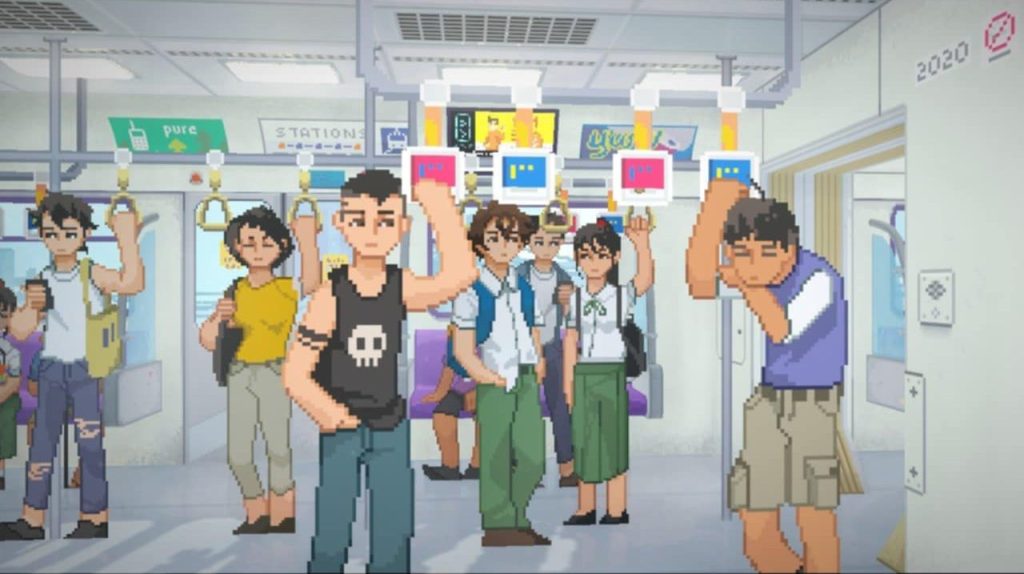
As a Filipino-Canadian, there is an unspoken disconnect we feel to our own country, our own culture. I’d hear about the Philippines from my parents, watch some dramas with them on TV, and even visited the country a couple times throughout my childhood. But I always wondered what everyday life was really like. What was it like to go to school, hang out with friends, or even fall in love, in such a distant place?
Although through a fictional pixel-art lens, Until Then gave me a chance to experience that. “From the time students need to wake up to get to class, to the commute, and the org (club) culture, it’s all very Filipino” said Pia (environment artist). “From the very first scene with Mark waking up to the alarm, it’s very accurate. Some classes in The Philippines start at 6 or 7 am and go until 5 or 6 pm.”
Lead Environment Artist Bea went on to say that many students also stay after school for their org (club) activities, the same way Mark and Nichole joined the classical piano org in the game.
The attention to detail is really what gave Until Then its polish and charm.
Pixel Art Graphics

Growing up in the 90s, pixel art is my jam. But as a Japanese visual novel lover, I was skeptical going in. Until Then is better described as a kinetic novel, with light gameplay elements, and character movement.
Unlike traditional visual novels, you physically need to move the characters in the game to progress the story. And for this, the pixel art lends itself very well to the story.
It also adds a bit of lightness to it, allowing the comedy and every day life of the story to shine through.
Because it was pixel art, I thought it’d be harder to feel emotion, to see emotion in the characters, but boy was I dead wrong.
Idle Motion: In traditional Japanese visual novels. Developers will add slight idle motion to the characters on screen so it always feels “alive”. You might see a character blink or their hair move, small details like that.
In Until Then, the characters are always slightly moving and I thought it was weird at first but you get used to it almost immediately. This effect gave the characters more life and felt like the world was more alive.
Music & Sound
Since Mark is trying to learn the piano, a lot of the soundtrack is made up of classical pieces like Wedding Day at Troldhaugen, and Fur Elise. But the original songs by Kyle Patrick Naval are what really give Until Then this sort of hauntingly beautiful atmosphere. Whether it be Butterflies in the Rain, Alive Again, or the song at the crux of the story, Time is Tearing Us Apart, every note touches the soul and seems to linger. You’ll find yourself almost holding your breath in anticipation of each note, hoping the song will never end.
Without the music, this game wouldn’t have been half as impactful. There’s something about the composition that just draws you in more to these characters, making you feel what they feel. And either every scene, with every note, the story seems to feel alot less like fiction, and more like real life.
The game deserves an award for the music alone!
Gameplay & Mini-Games
Like most kinetic novels, the gameplay consists mostly of walking, talking, and investigating. However, there are many things added in Until Then that keep you on your toes and make it feel more than just reading text.
Smartphone Mechanics
Many people often say it’s hard to write a love story set in modern times. Since the advent of the smartphone, there’s no more long lost lovers waiting for each other at the Eiffel Tower at midnight. No more love letters coming through the mail years late. As one of my favorite comedians Aziz Ansari put it “Text me that shit.”
However, Until Then manages to tell a love story, largely through a smartphone, beautifully.
While it’s a bit sad, for my generation (millenials) and beyond, a lot of our flirting happened over text. When Mark Borja stays up late at night to text his friends, or his love interest in the game, it brought me right back to my high school years doing exactly the same thing.
The Social Media Timeline
There is also a social media app on the phone which looks like Facebook. The attention to detail put into it worth praise. I thought, “Could you actually like these posts?” Yes you can.
Then, I thought, “Can you comment on the posts?” Yes you can.
The next question after that is logically, “Does it matter?” And to my surprise, it did! Some dialogue and texts in the game are only triggered if you like or comment on certain posts!
Mini-Games

While the game triumphs on story alone, the mini-games were so good! And I don’t mean like they’re brilliantly coded and immersive gameplay or anything like that. They are all pretty simple silly, and sometimes downright unnecessary mini-games.
However, the pacing of when they occur is perfect and they further help you understand small cultural nuances of The Philippines that most of us have no idea about. For example, there is a mini-game that takes place in a Jeepney, which is basically a bus in the Phillipines. And the goal of the game is to pass passenger’s money to the driver, because that’s how it really works when you ride one!
Until Next Time
While the story is about a very specific tragedy that most of us will never experience, we all have some tragedy. And for all of us tragedy hurts the same, no matter how big or small. We all know what it feels like to be brought to your knees in sadness, in heartbreak.
We all know what it feels like to think you can’t take it anymore, to want so badly to hear someone’s voice again. And for that, we all see ourselves in Mark. We know what it is to feel like you have no one to turn to. And for that, we all see ourselves in Cathy.
Little by little, we started to see ourselves in these characters, and that is what makes Until Then so special. It’s why the cult following is so strong because anyone who plays this game all the way through knows they experienced something special.
While I was doing my interview at TGS, a large Japanese guy came by and was kind of looking at us. I mean no disrespect to the man, because he’s a fellow gaming brother. But he had the stereotypical World of Warcraft type build and look. He was a bit overweight, glasses, but had a smile on his face when he finally spoke. He asked if he could take a picture of the Cathy plushie the team had put on display.
“Cathy Daisuki (I love Cathy),” was all he said, and that was enough. This Japanese man, miles away from my upbringing, with no connection or understanding of the Filipino culture of the game, was affected by it all the same. That’s the true power of art: to connect people and move people from all walks of life.
