

Breath of the Wild is considered by many to be one of the better Legend of Zelda games (if not the best of all time).
But did you know that Nintendo released multiple different special and collector’s editions?
Let’s take a look at the Japanese version of the Collector’s Edition for the Switch.
Breath of the Wild Switch Japanese Collector’s Edition Product Images and Overview

The Legend of Zelda (1986) was one of the first action-adventure (maybe RPG?) games available on Nintendo NES/ Famicom.
Zelda spawned a long line of games featuring the Hylian hero Link, who rescues Hyrule Princess Zelda from the villainous Ganon/ Ganondorf (named “Calamity Ganon” this time).
The Legend of Zelda: Breath of the Wild (2017) is the 19th game in the franchise. (This does not include spin-offs, or remakes.)
In terms of Link’s complicated timeline, Nintendo announced in 2024 that the game stands alone — along with its sequel, Tears of the Kingdom. The game was one of the last games for the Wii U, and among the first for the Switch. (It’s rumored that the Switch 2 will get a remaster.)
Multiple Releases

When the Switch version of Breath of the Wild came out, Nintendo released a standard edition, a Special Edition, and a Master Edition in the United States. Other versions included Europe’s Limited Edition.
Similarly, Japanese gamers got standard, Collector’s, and Deluxe Collector’s editions. Of the three, the Deluxe Collector’s edition came with the most stuff.
As far as the game itself is concerned, all of these versions are alike. (Even the Wii U game contains the same content, just at a lower resolution.)
For example, according to reports, you can play any Switch version of the game in the original Japanese just by changing your settings. You may want to do this if you don’t like the wonky translations in the localizations.
If you get the Japanese Collector’s edition, you will get different extras (and box art) from its American counterpart.
Breath of the Wild Switch Japanese Collector’s Edition Details & Images
When you open the box to the Collector’s Edition, you should find the following:
- Plastic case (containing the game)
- Alternate cover sheet
- Amiibo — Link (Rider)
- Sound Selection (soundtrack CD)
- Map
Box Art
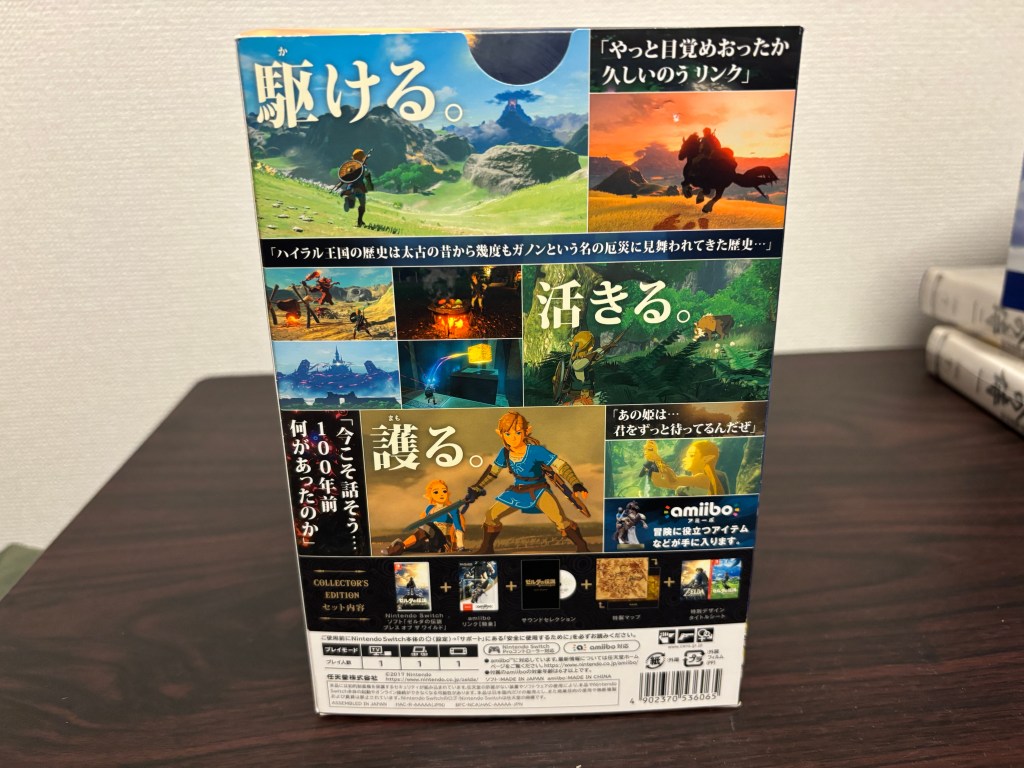
The box art features the same illustration as the front of the game case. Link stands on a ledge, looking out at the vast, wide-open landscape of Hyrule. Although the picture doesn’t appear to symbolize any specific location, it is evocative of the game’s “open sandbox” style of gameplay.
However, the back features multiple screenshots from the game, interspersed with quotes:
- “Run.”
- “So you’re finally awake. It has been quite a long time, Link.”
- “Since ancient times, the history of the Kingdom of Hyrule has been marked by a number of calamities called Ganon …”
- “Live.”
- “Now, let’s talk … about what happened 100 years ago.”
- “Protect.”
- “The princess has been waiting for you for a long time”
(Note: Some of these quotes don’t quite match up with the official U.S. English language translation, but the intent is the same.)
A small note in the corner shows which Amiibo you will get in the box. Underneath that is a list of what’s inside the Collector’s Edition: The game, the Amiibo, the soundtrack, map, and alternate cover.
The bottom of the backside of the box has all of the standard warnings and technical information for the game.
Plastic case and alternate cover art
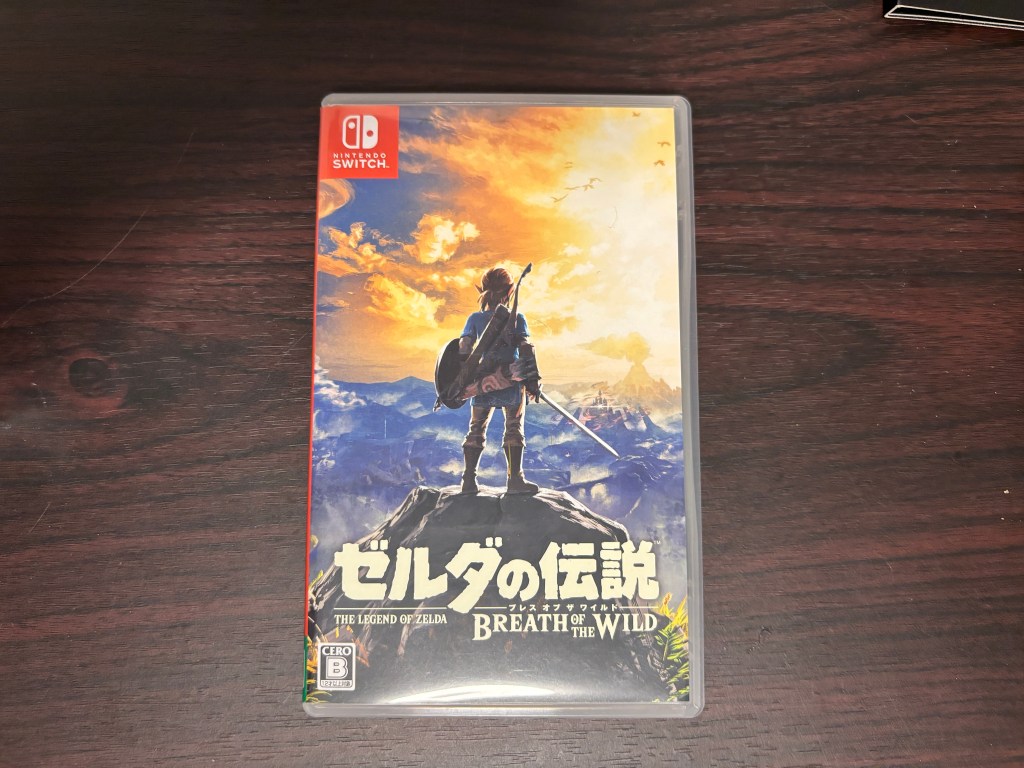
The cover art for the plastic case for the Japanese version of Breath of the Wild for the Switch is the same as the art on the front of the box. But that’s OK, because the art is epic and dramatic.
The case is about the same size as a DVD case, which makes it easy to store alongside a DVD or Blu-ray.
The “CERO: B” Japanese ratings mark at the bottom indicates that the game is for players aged 12 and above.

When you open the case, you see that it is comically huge for the size of the game contained within. But if it wasn’t, there wouldn’t be room for the lovely artwork. The art on the inside shows Link climbing a huge cliff, with some of Hyrule spread out behind him.

Incidentally, Nintendo changed the cover art for different markets. Japan and the U.S. got a dramatic and dark scene of Link looking out over Hyrule.
But Europe received the artwork found on the alternate cover art. In this version, Link stares back at the player. The scene is a bit lighter, with more blues and greens. On the back, Link poses dramatically with his various weapons and shield.

On the inside, the alternate cover art features the Master Sword. As the best weapon in the game, it naturally gets the Excalibur “Sword in the Stone” treatment.
Amiibo
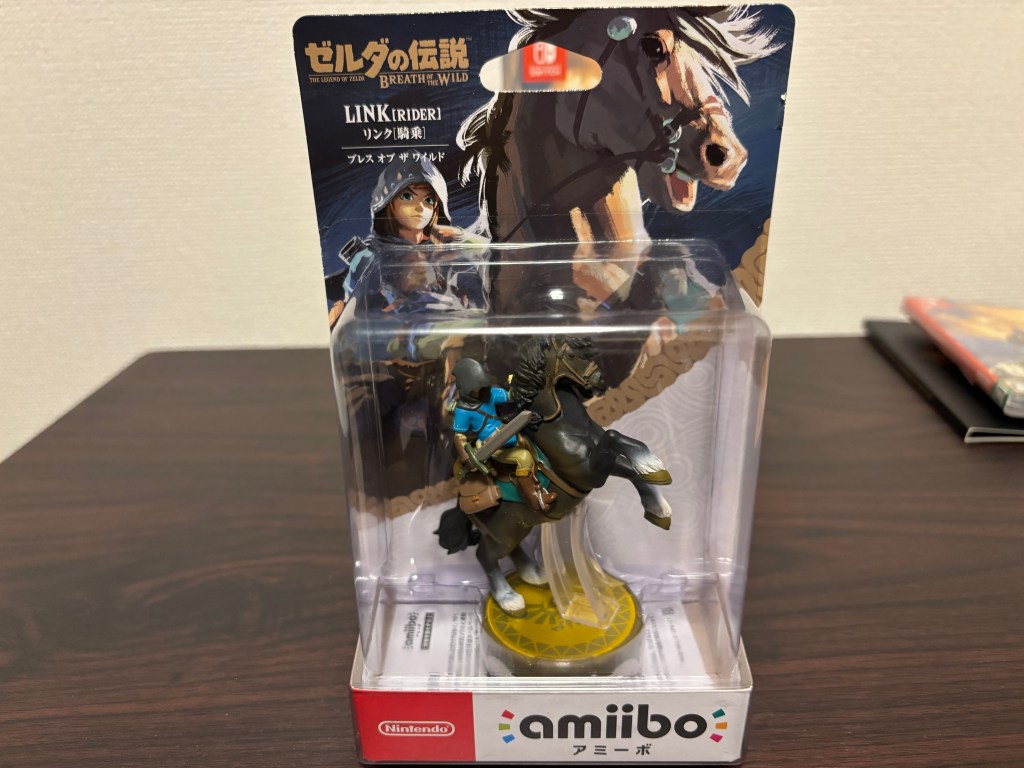
The game also comes with an Amiibo — specifically, the Link (Rider) Amiibo. The Amiibo depicts link on a rearing horse, while wearing a hood, and carrying a sword.
Like all Amiibo, this is more than just a figurine. When scanned by a Switch while playing Breath of the Wild, the Link (Rider) Amiibo will spawn a chest. According to Nintendo Life, this chest contains a random item. But it could contain: a broadsword, arrows, a bridle, or a saddle.
You may be wondering if the horse depicted in the Amiibo is Epona, Link’s steed in many of the games? Epona apparently can be summoned in the game, if you know how. But, as some have pointed out, Epona typically has a white mane.
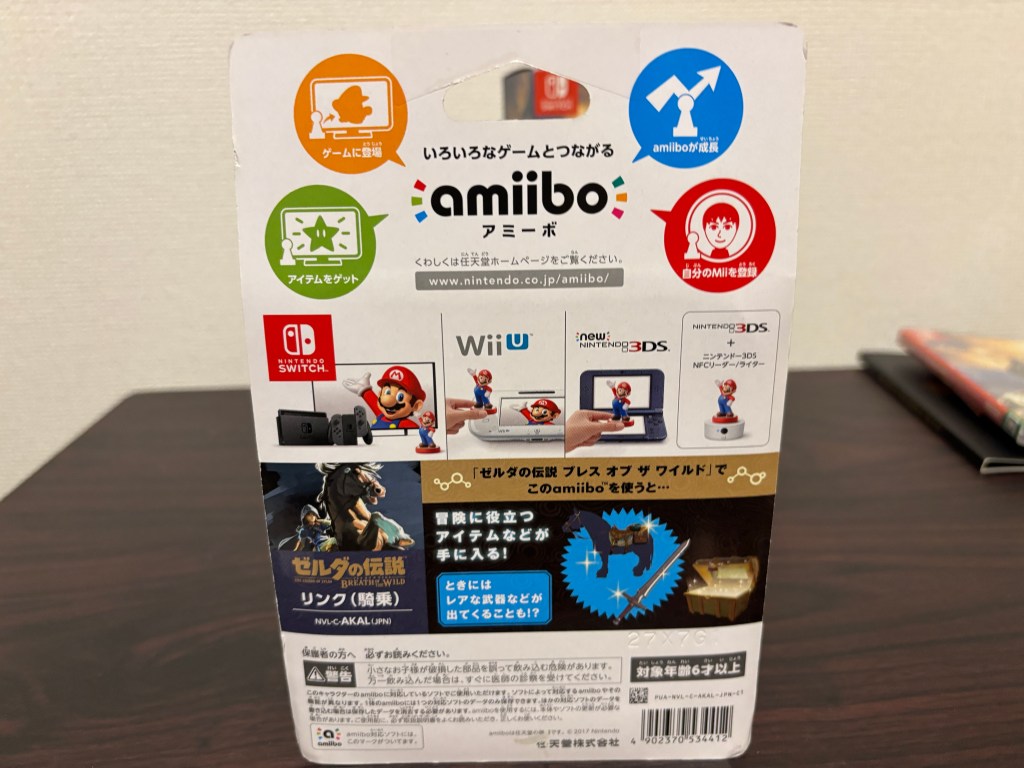
The back of the Amiibo box contains a lot of information to translate. It shows how your Amiibo can connect to games to get items. The Amiibo can also be registered with a Mii. The package also implies that Amiibo will go up in value.
It also shows that the Amiibo can be used with Switch, WiiU, 3DS, and an NFC reader for 3DS.
The box adds: “You can get items that will be useful for your adventure! Sometimes rare weapons may appear!”
At the bottom, the box lists off safety warnings, including, “There is a risk of small children swallowing parts” of the Amiibo.
Sound Selection (Soundtrack)
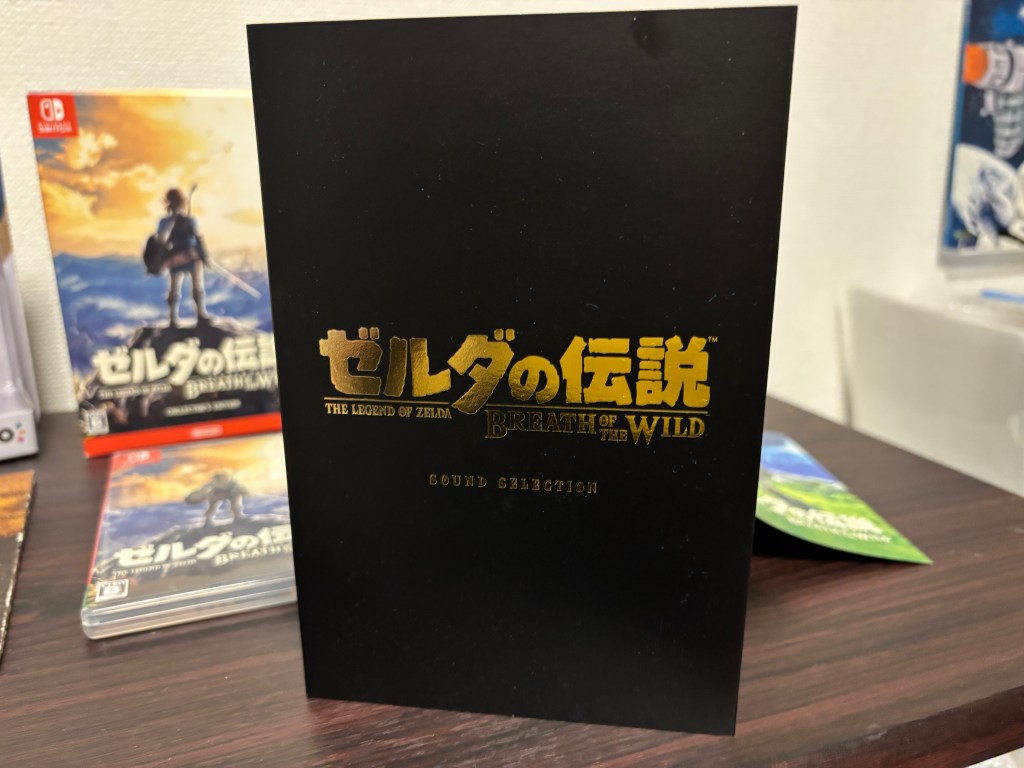
Breath of the Wild contains a unique combination of music in a variety of styles, including some lovely orchestral and piano pieces. It also includes Kass’s lively concertina/ accordion, and some rousing battle themes.
The Sound Selection CD includes a mixture of these. The music fits well with the fantasy/ adventure nature of the game.

As you can see from the above list, the Sound Selection CD includes 24 tracks: the Main Theme, Field (Day), Battle (Field), Shrine, Battle (Shrine), Riding (Daytime), Riding (Night), The Temple of Time, Guardian Battle, Iwarok (or Talus) Battle, Hinox Battle, Stables, Kass’s Theme, Kakariko Village (Daytime), Rito Village (Night), Goron City (Daytime), Goron City (Night), Zora’s Domain (Daytime), Zora’s Village (Night), Gerudo Town (Daytime), Gerudo Town (Night), and Main Theme Concert Version.
Map
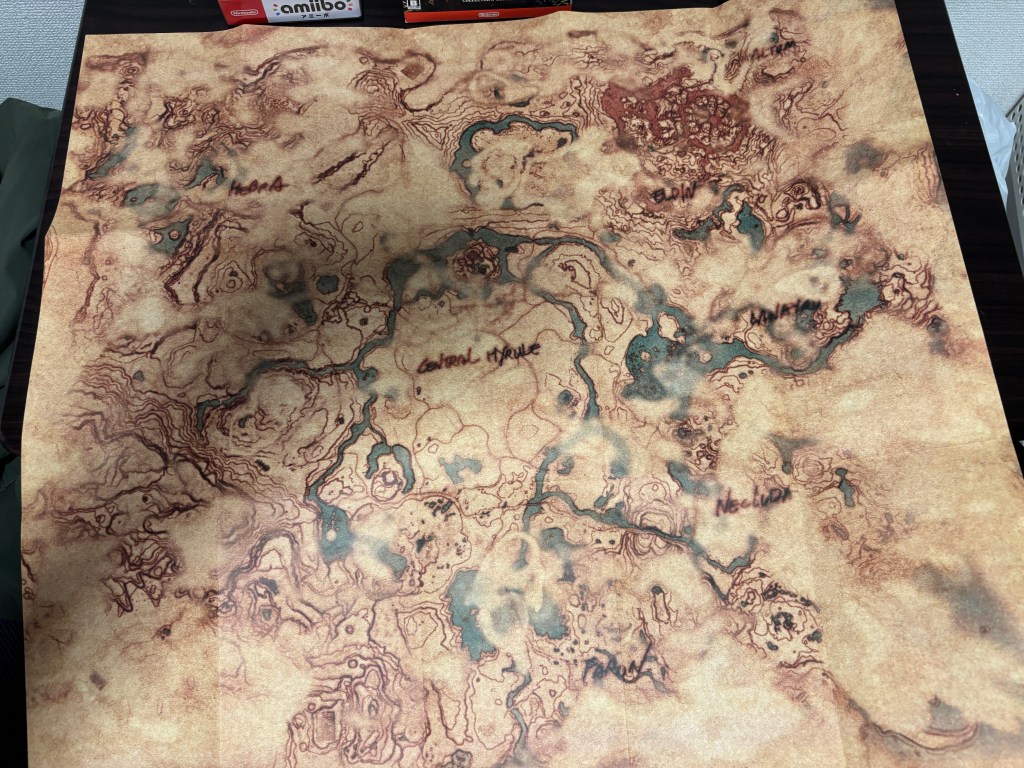
This map of the Kingdom of Hyrule (really a poster reproduction) looks like something Indiana Jones might have. It’s old, and it looks like it got wet and smudged at some point.
If you’re looking for a map full of secrets to help you win the game, this isn’t it. But it is a pretty cool thing to have.

If you flip the Hyrule map over, the back features a print poster copy of the Calamity Ganon Tapestry from the game.
The small text at the top of the tapestry is the same as one of the quotes on the box. It reads, “since ancient times, the history of the Kingdom of Hyrule has been marked by a number of calamities called Ganon …”
📦 Recent eBay Listings
-
Price Range: Recent listings on eBay for the Japanese Collector’s Edition range from approximately $178 to $375.
- Listing: Link
📊 Market Insights
-
Availability: The Collector’s Edition is relatively rare. That helps explain its higher price.
-
Collector Interest: As a limited release with unique content, the Collector’s Edition holds strong interest among enthusiasts and collectors.
